Table of Contents
When engineering teams and product leaders evaluate AI meeting tools, they often focus on UI elements—calendar integrations, dark mode, or mobile apps.
However, the defining component of any meeting intelligence system is the underlying Large Language Model (LLM). Which model reads the raw transcript, extracts key decisions, assigns task ownership, and formats the executive summary?
In 2026, most commercial meeting software architectures rely on either Google's Gemini models, OpenAI's GPT family, or open-weight models like Meta's Llama 3.3.
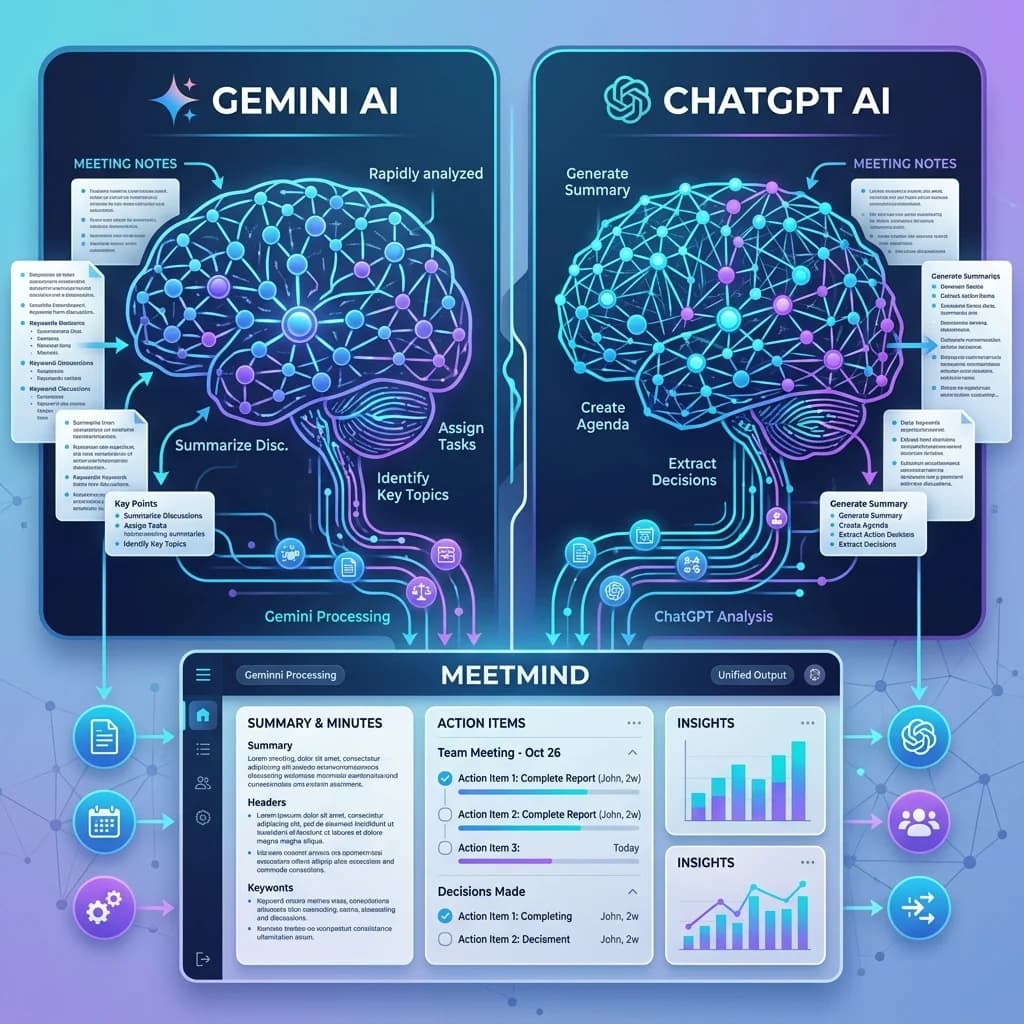
Each model family presents distinct trade-offs in context window capacity, semantic smoothing, schema obedience, and latency. Here is a technical breakdown of how Gemini and ChatGPT compare when handling conversational speech transcripts.
Architectural Comparison Framework
To evaluate LLMs for meeting intelligence, systems engineers must look beyond general chatbot benchmarks (like MMLU or Chatbot Arena) and evaluate how models behave under specific speech-to-text constraints:
- ASR Handoff & Error Tolerance: How effectively the model interprets unpunctuated, rapid-fire, or disfluent automatic speech recognition (ASR) transcripts without dropping facts or hallucinating missing audio.
- Context Window vs. Chunking Overhead: The operational trade-off between feeding an entire multi-hour transcript into a massive context window versus splitting text into semantic chunks.
- Structured JSON Extraction: The model's reliability in returning strictly valid JSON matching predefined schemas (e.g.
title,executiveSummary,actionItems,decisions) without markdown fences or schema deviations. - Data Privacy & API Terms: Commercial data isolation guarantees, zero-training commitments, and token pricing based on official API documentation.
Methodology & Scope Note: This guide is an architectural analysis based on official developer documentation, published API pricing, and prompt engineering constraints as of 2026. It is not an empirical benchmark with synthetic accuracy scores; real-world performance depends heavily on prompt design, audio quality, and upstream transcription fidelity.
1. Transcript Quality and ASR Handoff
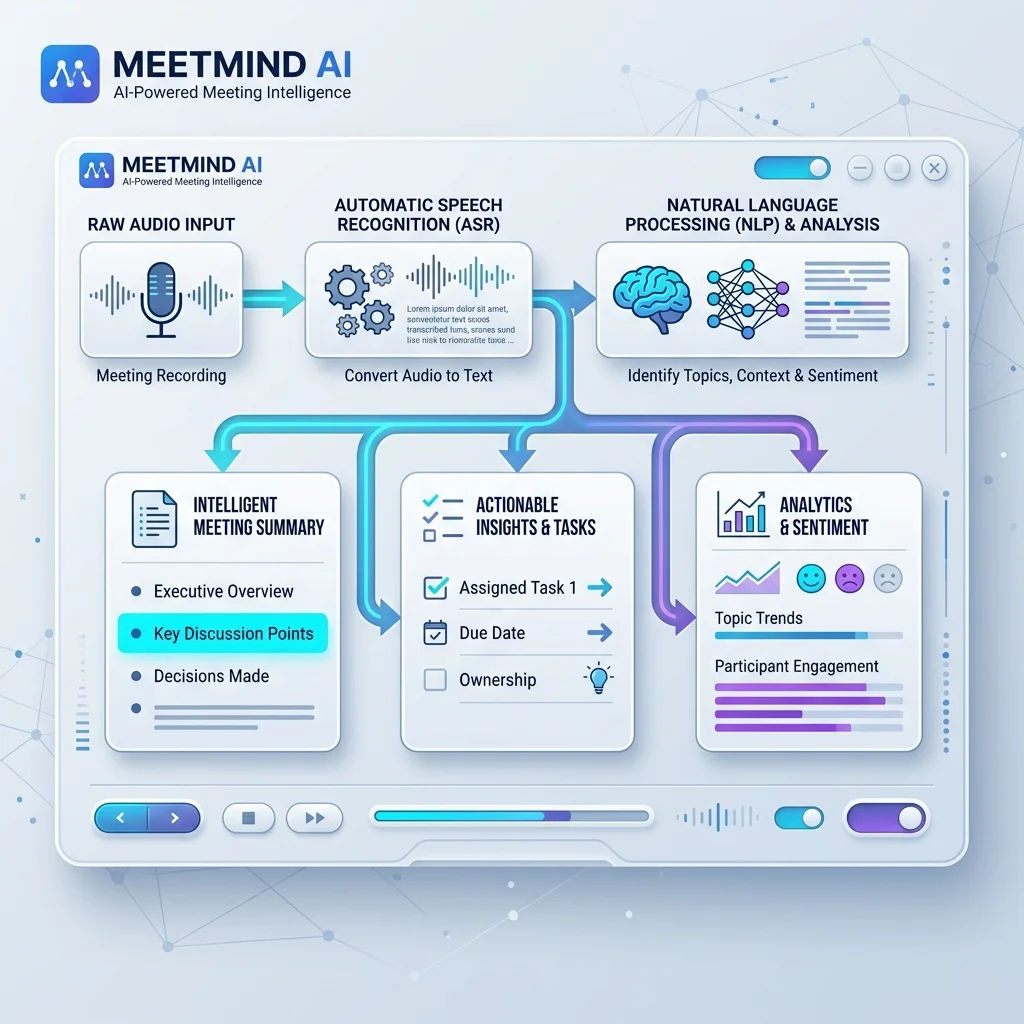
Neither ChatGPT nor Gemini typically transcribes audio directly in meeting applications. That task belongs to an Automatic Speech Recognition (ASR) system, such as Whisper or Deepgram. The LLM's job begins when it receives a massive payload of raw text.
[Raw Audio File] ──> [ASR Engine (Whisper/Deepgram)] ──> [Raw Text Transcript] ──> [LLM Prompt] ──> [Structured JSON Output]
How ChatGPT Handles Messy Transcripts
When an ASR model encounters poor audio, rapid cross-talk, or strong accents, it often outputs grammatically fragmented sentences with missing punctuation.
OpenAI's GPT-4o architecture possesses significant "semantic smoothing." If a transcript contains conversational filler:
"yeah so we gotta ship the uh the database migration by friday right yeah friday noon"
ChatGPT reliably extracts the core commitment: "Complete database migration by Friday at 12:00 PM."
The operational trade-off is that aggressive smoothing can occasionally filter out technical caveats or tentative phrasing (e.g., mistaking an exploratory suggestion for a finalized decision).
How Gemini Handles Messy Transcripts
Gemini models (such as Gemini 1.5 Pro and 1.5 Flash) tend to be more literal. When provided with unpunctuated text, Gemini sticks closely to the exact sequence of tokens.
This literal interpretation reduces the risk of over-inferring commitments. However, if the transcript lacks speaker labels, Gemini can be hesitant to assign action items to specific individuals unless the speaker's name was explicitly verbalized in the surrounding sentence.
2. Context Window Scaling: Massive Prompts vs. Chunking
For a 30-minute standup, context window limitations are negligible. But for a multi-hour strategic planning session or an all-day conference, context management dictates system design.
Gemini's Native Context Window
Google's Gemini 1.5 architecture supports context windows exceeding 1 million tokens.
In practical engineering terms, this allows a developer to pass the entire transcript of an 8-hour executive offsite into a single API call. You can then prompt:
"Identify every instance where the engineering timeline contradicted the sales commitments made during morning sessions."
Gemini reads the entire context simultaneously, making it suitable for monolithic qualitative document ingestion without requiring complex retrieval pipelines.
ChatGPT's Chunking Trade-off
While OpenAI has expanded context windows up to 128k tokens (sufficient for approximately 6 to 8 hours of spoken dialogue), long prompts carry higher latency and cost.
To optimize latency, developers frequently build semantic chunking pipelines:
- Divide long transcripts into 15–30 minute conversational blocks.
- Extract localized action items and decisions per block.
- Pass localized summaries into a final synthesis prompt.
The Trade-off: Semantic chunking reduces API cost and latency, but risks dropping subtle connections discussed across non-adjacent segments of a long meeting.
3. Structured JSON Obedience for Automation
Meeting intelligence tools must output structured data to be actionable. A raw paragraph summary cannot be reliably parsed into database columns or exported to issue trackers.
{
  "title": "Q3 Infrastructure Planning",
  "executiveSummary": "Team approved migrating primary databases to PostgreSQL with connection pooling.",
  "actionItems": [
    "Alex: Deploy read replica in staging by Thursday",
    "Priya: Update database connection strings"
  ],
  "decisions": [
    "Standardize on PostgreSQL 16 for all new microservices"
  ]
}
ChatGPT & Structured Outputs
OpenAI's response_format configuration and formal JSON Schema enforcement (json_schema) provide high reliability. When a prompt defines an exact array schema, GPT models adhere to the specification with minimal syntax errors, making them a popular choice for developers building strict downstream pipelines.
Gemini & Structured Generation
Google provides structured schema output options via the Gemini API (response_schema). When properly configured with typed Pydantic models or JSON schemas, Gemini adheres cleanly to formatting requirements. In raw prompt scenarios without schema enforcement, however, earlier versions occasionally wrapped JSON in Markdown fences (```json), requiring server-side string sanitation.
4. Hallucination Guardrails & Failure Modes
All generative models can generate inaccuracies when prompted with ambiguous context. However, their failure modes differ:
| Dimension | OpenAI ChatGPT | Google Gemini |
|---|---|---|
| Typical Failure Mode | Plausible extrapolation: May infer deadlines or owners from statistical likelihood if audio is ambiguous. | Over-caution / Safety block: Can trigger safety filters on technical jargon (e.g. "kill process", "penetration test"). |
| Hallucination Mitigation | Strict negative constraints ("If not mentioned, write 'Unassigned'"). | Explicit system instructions restricting answers strictly to provided text tokens. |
| Transcript Fidelity | High semantic coherence; occasional loss of conversational hedging. | High verbatim adherence; requires clean upstream speaker labeling. |
5. Enterprise API Privacy & Commercial Terms
Using AI models for confidential meetings requires evaluating data privacy policies.
Crucial Distinction: There is a fundamental legal difference between using consumer web applications (e.g. chat.openai.com or gemini.google.com) and commercial developer APIs.
- Consumer Web Interfaces: By default, consumer chat interfaces may use user inputs to train public foundation models unless users explicitly opt out. Proprietary meeting recordings should never be pasted into consumer chat windows.
- Commercial Developer APIs: Both Google Cloud Vertex AI and OpenAI's API operate under commercial terms stating that customer API inputs and outputs are not used to train foundation models. Data is encrypted in transit and at rest.
Organizations evaluating meeting software should always confirm that the vendor utilizes commercial API endpoints with explicit zero-training commitments.
6. How MeetMind AI Approaches Model Selection
Rather than relying blindly on general-purpose frontier models, MeetMind AI uses an optimized, multi-stage pipeline:
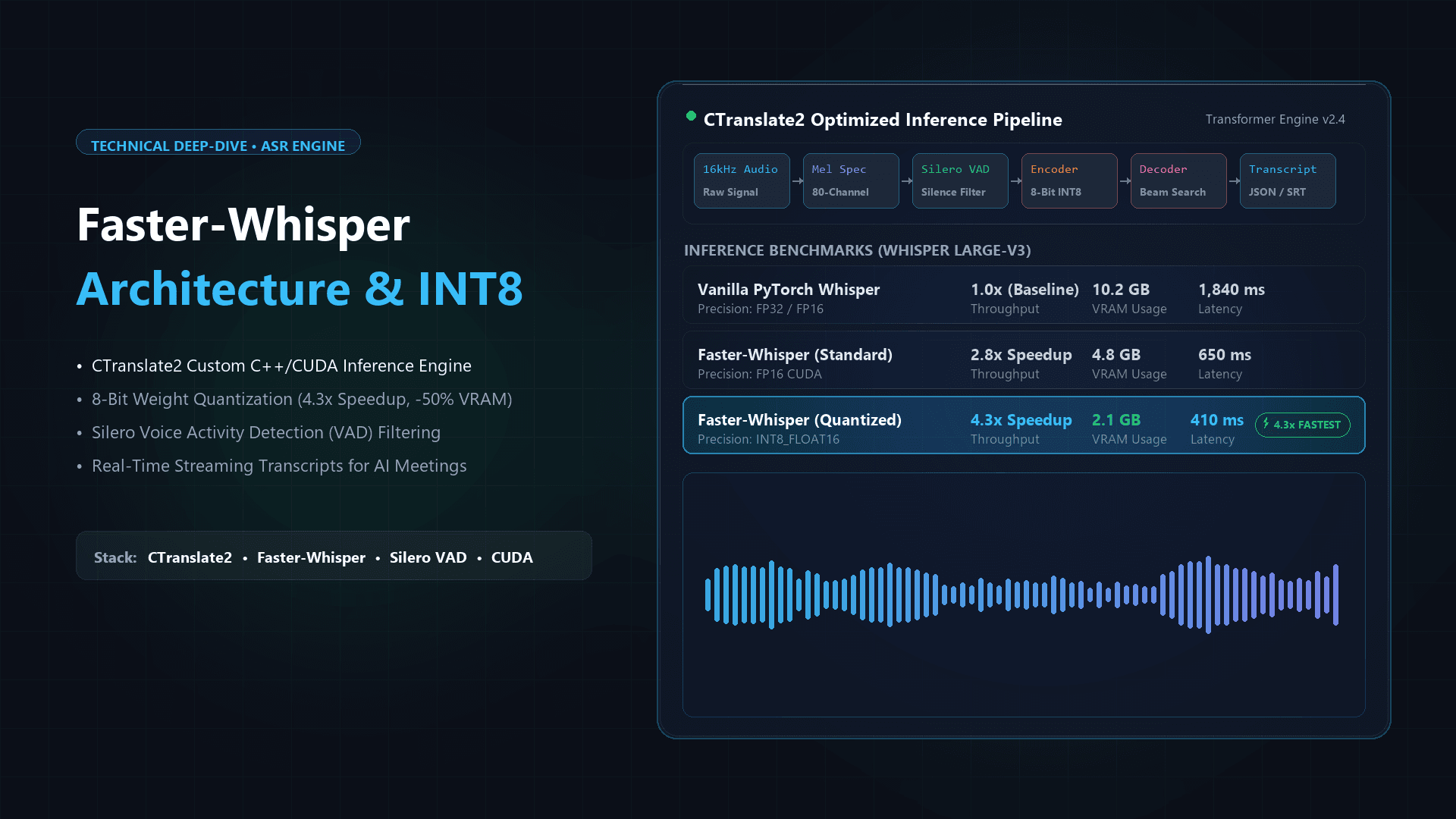
- ASR Stage: OpenAI's Whisper Large v3 hosted on Groq's high-speed inference hardware for sub-second transcription, with Deepgram Nova-3 available for multi-speaker diarization.
- Extraction Stage: Llama 3.3 70B running on Groq LPUs. This delivers the reasoning depth of a 70B parameter model while returning structured JSON payloads in seconds—eliminating the latency of general multi-tenant cloud APIs.
- Privacy by Design: Audio files are stored temporarily on the server and deleted immediately following transcription. Transcripts are stored in Supabase with user-isolated Row-Level Security (RLS).
To learn more about the engineering details, explore our technical breakdown of How MeetMind AI Works and read our guide on AI Meeting Assistant Privacy & Recording.

Written by Abhishek
I created MeetMind AI to eliminate manual note-taking and ensure teams never lose critical decisions or action items after a call. All technical content is verified against our current codebase.
Read Founder ProfileReady to eliminate manual meeting notes?
Secure your meeting data while generating accurate AI summaries in minutes.
- AI Meeting Notes & Summaries
- Automated Action Item Tracking
- Search Across Every Meeting